


R&D
Introducing Our Lab
YiPSCELL is Korea’s first biotechnology company based on induced pluripotent stem cell (iPSC) technology. Using our precise iPSC technology, we provide profound and effective treatment to patients. Also, we aim to focus on utilizing iPSCs in order to develop novel treatments. We are capable of generating cell lines from both healthy people and the patients, which are necessary for disease modeling and developing iPSC-based therapeutic agents.


-
1
Mesenchymal Stem Cell, MSC
YiPSCELL has conducted research on disease mechanism and therapeutic effects using minicircle transfected mesenchymal stem cells.
-
2
Citrulline Detecting Antibody
YiPSCELL has developed citrulline detecting antibody in order to diagnose Rheumatoid arthritis.
-
3
Patient-derived and HLA-Homozygous iPSC banking
We have established a cell bank of patient-derived iPSCs as well as iPSCs from those suffering from autoimmune diseases. Since 2013, we have been coworking with Korea Disease Control and Prevention Agency (KDCA) and Ministry of Health and Welfare (MOHW), hence established iPSCs approved of clinical grade.
-
4
Disease modeling and regenerative medicine
Our laboratory is developing differentiation technology of chondrocyte, cardiomyocyte, bone, skin, and hepatocyte using clinical grade iPSC lines. And we research disease mechanism using disease iPSC lines.
-
5
Cell therapy derived from induced pluripotent stem cells
- MIUChon™ : Injectable 3D chondrocyte therapy from clinical-grade iPSCs (in clinical study)
- Universal iPSC : Hypoimmunogenic universal iPSC lines
- i-Mitochondria : Research on iPSC-derived mitochondria for degenerative diseases
- i-RBC : Production of iPSC-derived artificial red blood cells
MIUChon™
Aug 2024 clinical study approved · Apr 2025 first patient dosed · Jul 2026 one-year safety in the first 3 patients · Oct 2026 dosing completed in the 30-patient randomized controlled study
An injectable 3D chondrogenic micropellet therapy for osteoarthritis made from clinical-grade iPSCs
MIUChon™ (Minimal Injectable Unit Chondrospheroid) is an allogeneic cell therapy in which clinical-grade iPSCs are differentiated into chondrocytes and formed into uniform 3D chondrogenic micropellets of about 200 µm. It is delivered by a single intra-articular knee injection, without surgical implantation, and aims to restore damaged cartilage structure rather than only relieve pain.
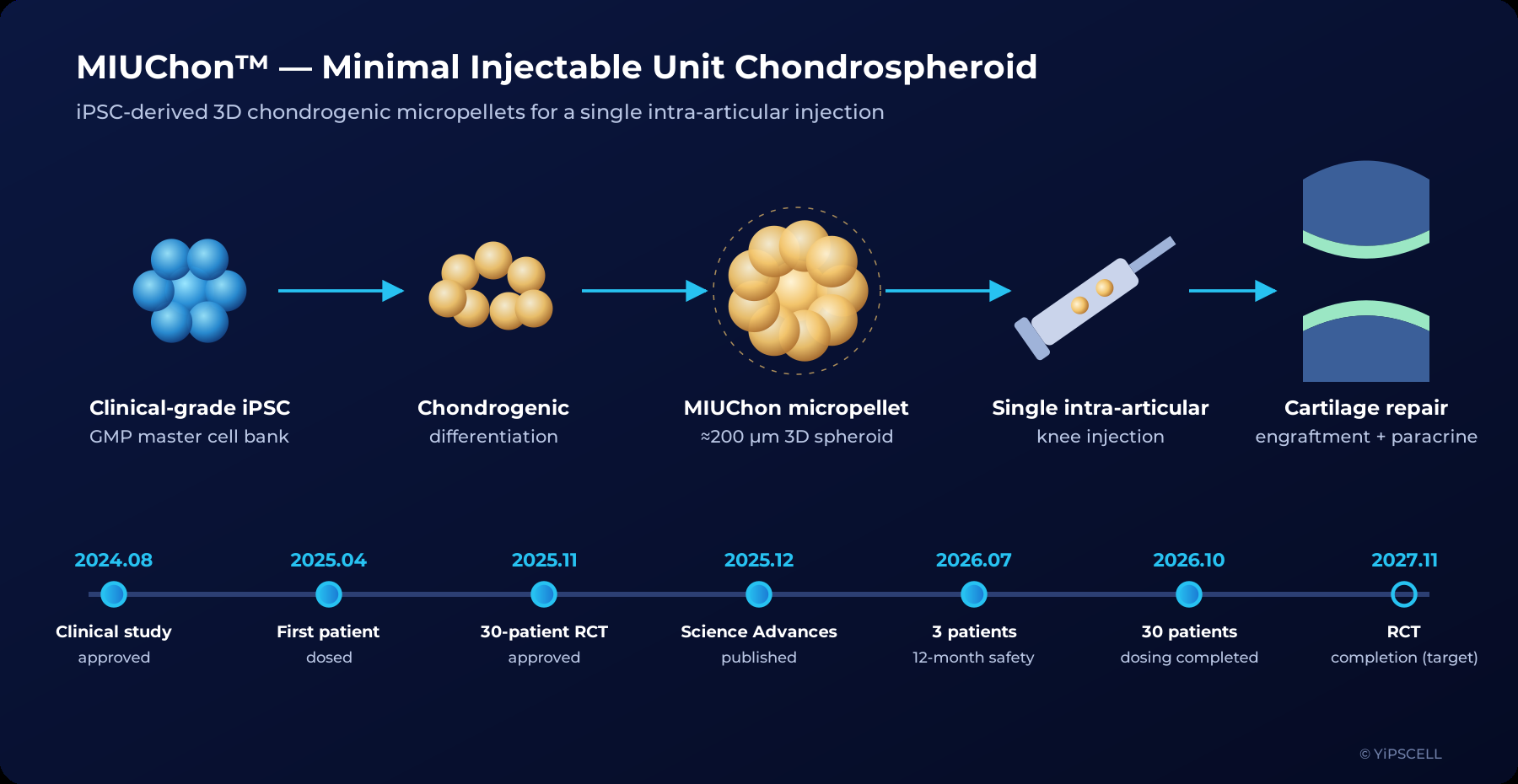
Mechanism of action
- Direct regeneration — injected micropellets engraft in the defect and form new cartilage matrix.
- Paracrine action — secreted growth factors and anti-inflammatory signals reduce joint inflammation and support repair.
- Increases in cartilage thickness and volume, defect repair and improved gait were confirmed step by step in rodent and rabbit models and in large-animal (beagle and minipig) models.
- Manufactured with a clinical-grade process; no teratoma formation or clinically meaningful genomic abnormality was observed in residual-pluripotency, genetic-stability and tumorigenicity assessments.
Clinical development
- Aug 2024Clinical study approved by the Korean review committee for advanced regenerative medicine (pilot safety study)
- Apr 2025First patient dosed at Seoul St. Mary’s Hospital — the first clinical administration of an iPSC-based cell therapy in Korea
- Nov 202530-patient randomized, double-blind, placebo-controlled study approved
- Jul 202612-month follow-up completed in all 3 pilot patients with no serious treatment-related adverse events
- Aug 2026One-year results presented at the Korean Society for Stem Cell Research — serial MRI showed reduced defects and recovering cartilage thickness (exploratory)
- Oct 2026Dosing completed in the 30-patient study; follow-up ongoing (completion targeted for Nov 2027)
The clinical-grade manufacturing process and preclinical results of MIUChon were published in Science Advances 2025;11(51):eadw4911. The pilot clinical study was conducted with Seoul St. Mary’s Hospital and the College of Medicine, The Catholic University of Korea.


Universal iPSC
Published in Experimental & Molecular Medicine (2025) · Korean patent granted Oct 2026
Hypoimmunogenic universal iPSCs with selectively edited HLA genes
Universal iPSC is a hypoimmunogenic iPSC platform in which the HLA genes that drive transplant rejection are selectively regulated, so that a single cell line can serve a broader range of patients.
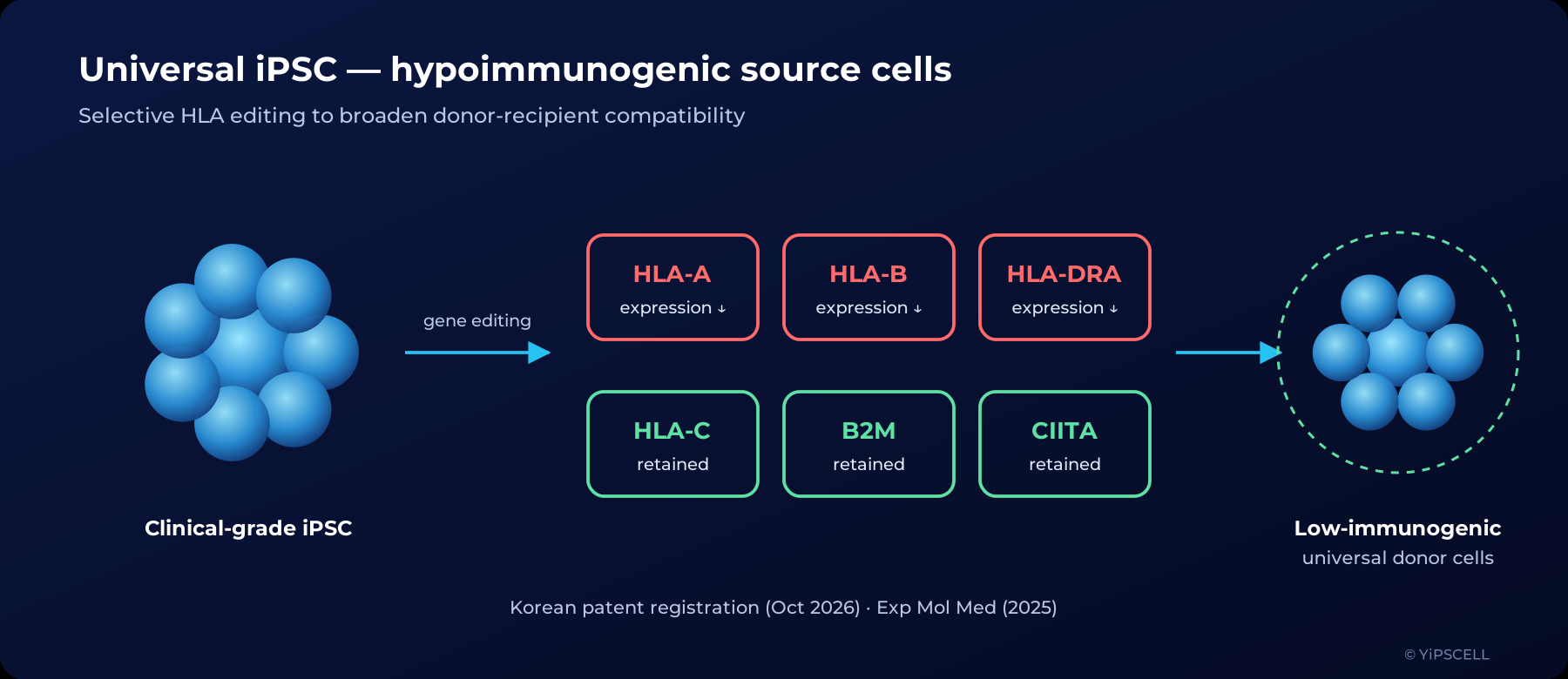
- Expression of HLA-A, HLA-B and HLA-DRA (the shared alpha chain of HLA-DR) is reduced, while HLA-C, B2M and CIITA are retained.
- Stem-cell properties and differentiation capacity are maintained after editing, and low immunogenicity was confirmed in in-vitro immune-cell assays (Experimental & Molecular Medicine, 2025).
- A Korean patent covering the source cells and their manufacturing method was granted in October 2026.
- Clinical-grade universal lines are being developed under a Scale-up TIPS program of the Ministry of SMEs and Startups.
YiPSCELL will use universal lines both to advance its own pipeline and as a foundation for cell-line supply, co-development and licensing. Safety and efficacy of each therapy will be verified for each differentiated cell type and indication.
i-Mitochondria
Research stage
Research on transferring healthy iPSC-derived mitochondria for degenerative diseases
Mitochondria produce the energy (ATP) that cells use, and their dysfunction drives degeneration of neurons and many other cell types. i-Mitochondria studies a therapeutic strategy that delivers healthy mitochondria obtained from clinical-grade iPSCs into damaged cells to restore energy metabolism and cell function.
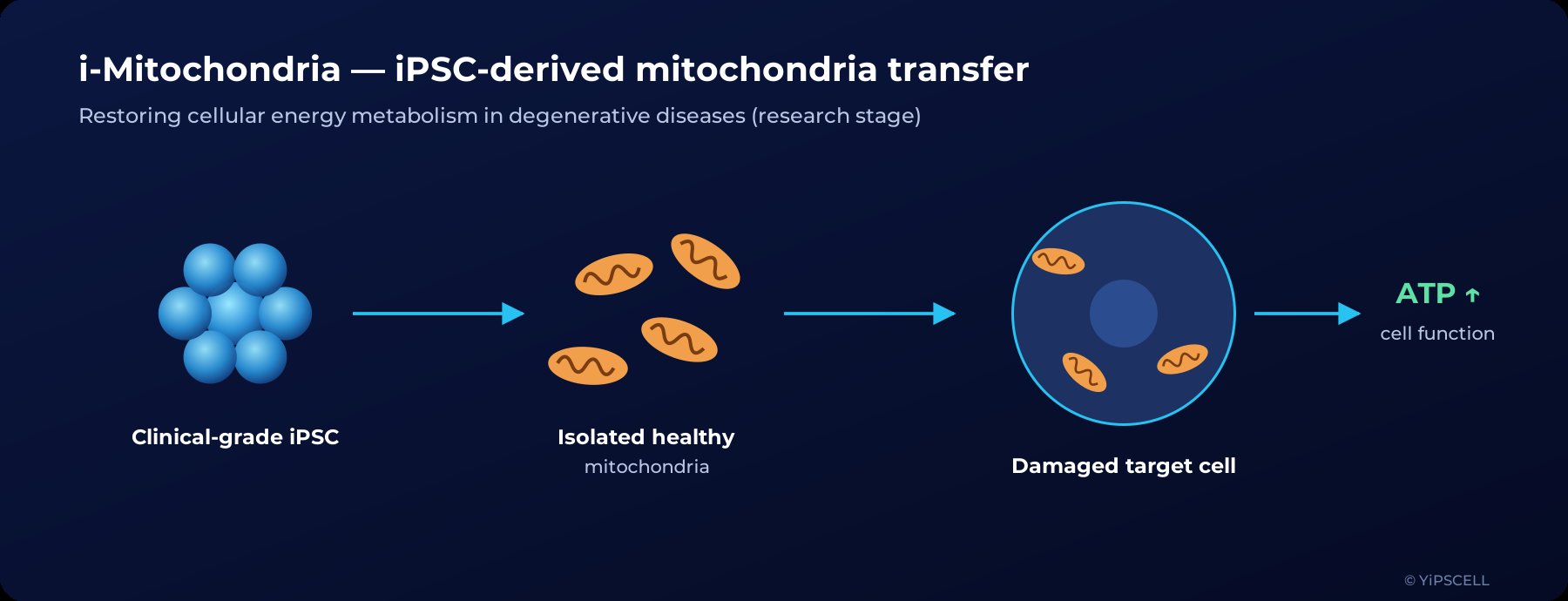
- Uniform-quality iPSCs provide a consistent, scalable source of mitochondria.
- Our main targets are degenerative brain diseases such as Alzheimer’s disease, using YiPSCELL’s Alzheimer’s patient-derived iPSC lines (iCellHub-NeuroAD-RUO™) as evaluation models.
i-RBC
Multi-ministry national program · co-development with Daewoong Pharmaceutical
Artificial blood technology for large-scale production of transfusable RBCs from clinical-grade iPSCs
Low birth rates, an ageing population and infectious-disease outbreaks are straining blood supplies that depend solely on donation. i-RBC aims to produce a stable supply of artificial red blood cells by differentiating clinical-grade iPSCs, which can expand indefinitely, through hematopoietic progenitors and erythroblasts into mature RBCs.
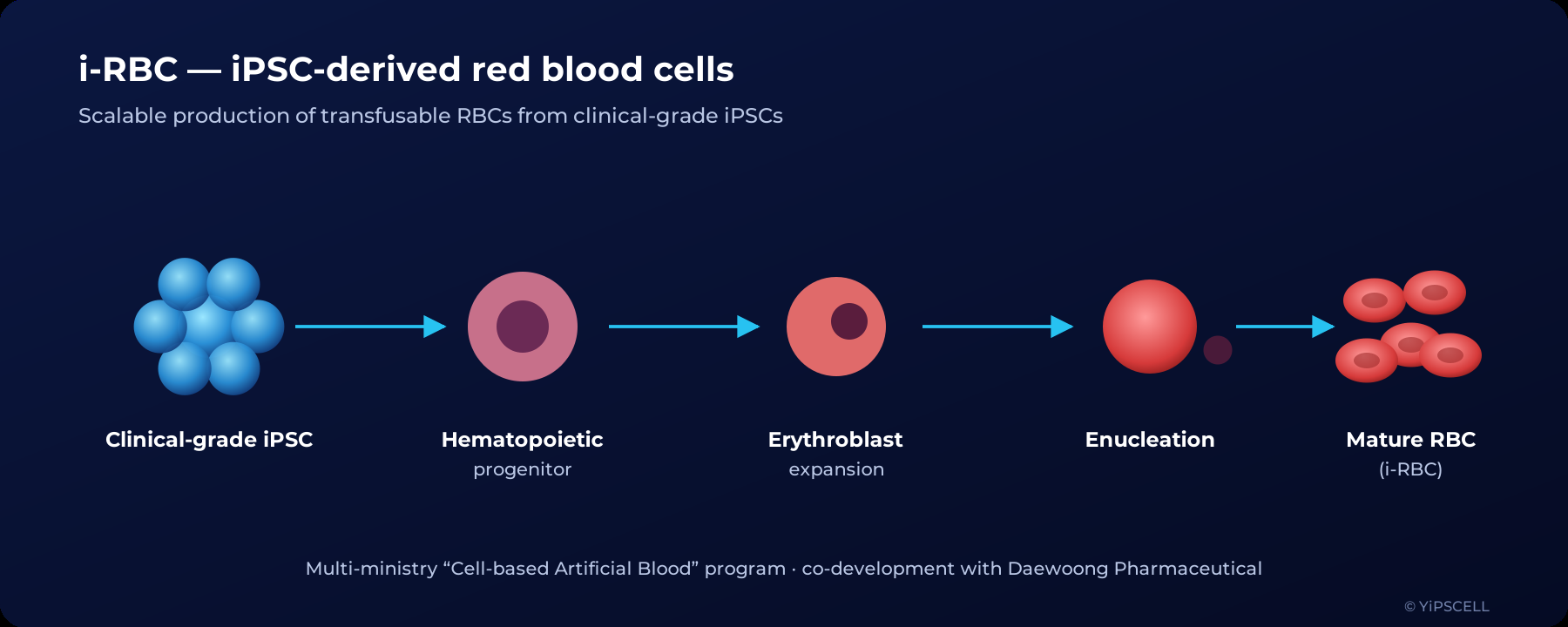
- In May 2023 we signed a joint R&D agreement with Daewoong Pharmaceutical on artificial red blood cells, covering cell-line and process development.
- In 2023 we were selected for the RBC production project of Korea’s multi-ministry program on cell-based artificial blood manufacturing and demonstration (about KRW 4.5 billion over five years).
- Together with the Catholic University iPSC research institute (CiSTEM), Daewoong Pharmaceutical and Hanmaeum Blood Center, we aim to establish commercial-scale production technology and file an IND.
Publication
-
2026
- A stroma-sensing TGF-β blockade reprograms CAF-myeloid niches to induce durable tumor immunity
- Kang DW, Bae JB, Yoo S, Kim H, Kim P, Mo J, Kim J, Kim JS, Yoon K, Kim YS, Lee JS, … Kim SJ
- Cancer Cell. 2026 Nov 9;44(11):2227-2248.e21
-
2026
- Engineering autoimmune disease models using organoids: Harnessing microenvironmental engineering for precision medicine and immunological recapitulation
- Lee CJ, Kim Y, Kim M, Rim YA, Ju JH
- Bioeng Transl Med. 2026 Sep;11(5):e70162
-
2026
- Mesenchymal stem cells derived from human bone marrow ameliorate monosodium urate crystal-induced inflammation
- Choi A, Park N, Jung H, Rim YA, Yoo H, Ju JH, Kwok SK, Park SH, Lee JJ
- Biochim Biophys Acta Mol Basis Dis. 2026 Apr;1872(4):168193
-
2026
- Ligand-dependent Wnt signaling promotes gastric cancer metastasis through hyaluronan expression in microenvironment
- Furutani Y, Oshima H, Hong CP, Choi S, Machi R, Nakayama M, Murakami K, Yagi S, Ito Y, Maeda D, Inaki N, … Oshima M
- Nat Commun. 2026 Feb 14;17(1)
-
2026
- Harnessing induced pluripotent stem cells and organoids for disease modeling and precision medicine
- Lee CJ, Nam Y, Rim YA, Ju JH
- Stem Cell Res Ther. 2026 Feb 8;17(1)
-
2025
- Clinical-grade iPSC-derived chondrogenic micropellets for treating advanced cartilage defects
- Nam Y, Park N, Choi J, Lee K, Choi SH, Kim JW, Choi S, Hong CP, Lee J, Jung JY, Oh SN, … Ju JH
- Sci Adv. 2025 Dec 19;11(51):eadw4911
Patents
-
2026
- Composition comprising component derived from induced pluripotent stem cell culture medium and uses thereof
- Registration No. 10-3041904 · 2026-10-28
-
2026
- Method for isolating single cells from cell spheroids
- Registration No. 10-2922517 · 2026-01-30
-
2025
- Biomarkers for quality assessment of chondrospheroids and uses thereof
- Registration No. 10-2885476 · 2025-11-10
-
2025
- Method for selecting induced pluripotent stem cell clones with genetic and culture stability
- Registration No. 10-2882714 · 2025-11-03
-
2024
- Composition for monitoring a stem cell, kit and method for monitoring the stem cell using the same
- Registration No. 10-2681869 · 2024-07-01
-
2022
- Method of preparing pellets of chondrocytes differentiated from human induced pluripotent stem cells and use of the same
- Registration No. 10-2479530 · 2022-12-13
